Telling Time and Making Plans in Saudi Arabic
How to tell the time in Saudi Arabic and make plans that actually happen — the clock, prayer-time markers, days of the week, and what inshallah really means.

Arabic script, easy pronunciation and plain English — sent to your inbox in about a minute.
A colleague tells you he will call you بعدين — ba3deen — "later". A neighbour says he will come by بعد المغرب — ba3d al-maghrib — "after sunset prayer". A friend agrees to dinner with إن شاء الله — inshallah. Three appointments have just been made, or possibly none of them have, and if you cannot read the difference you will spend your first year here waiting for people who were never coming.
Time in Saudi Arabia is spoken about differently than it is written in a calendar app. The clock is there, but so is the prayer schedule, and so is a layer of polite vagueness that carries real meaning once you learn to hear it. This guide covers all three: how to say a time in everyday Saudi Arabic, how to propose and confirm a plan, and how to tell a firm yes from a soft no. Every phrase is in spoken Saudi dialect, with Arabic script, a simple transliteration and the English meaning.
The Clock: One Word and a Number
The word for "hour" and "clock" is the same: ساعة — saa3a. Put "the" in front of it and a number after it, and you have told the time. There is no "o'clock" to add and no verb to conjugate.
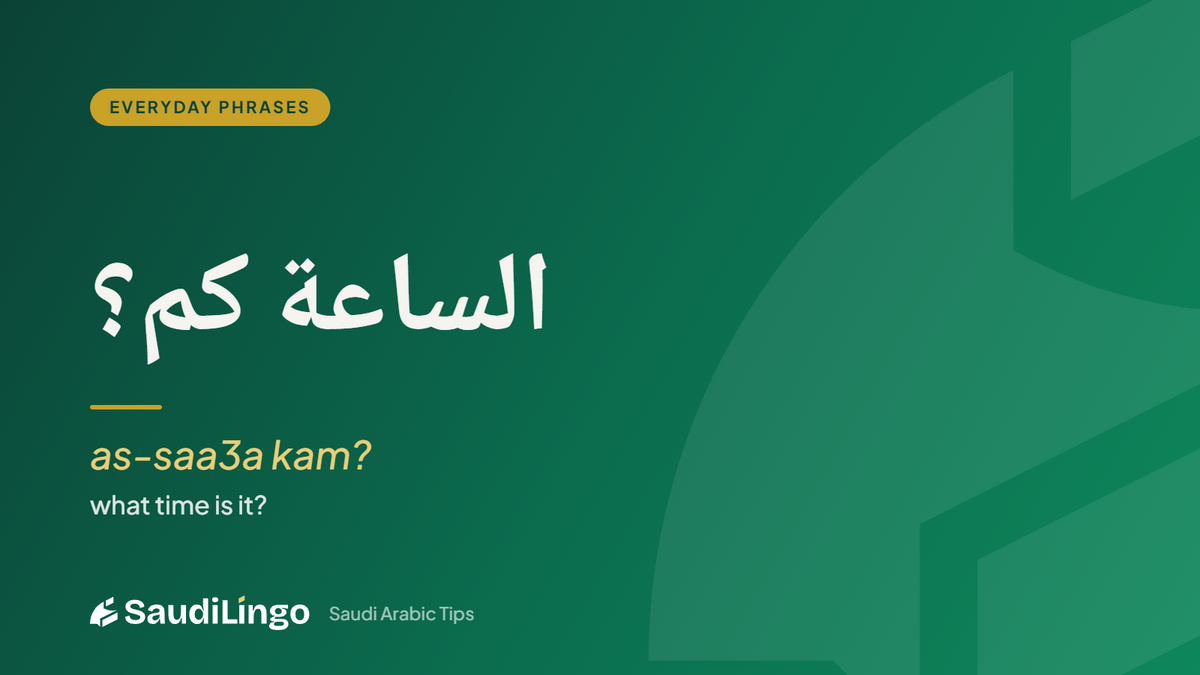
- الساعة كم؟ — as-saa3a kam? — "What time is it?"
- الساعة ثلاثة — as-saa3a thalaatha — "It's three o'clock."
- الساعة كم الموعد؟ — as-saa3a kam al-maw3id? — "What time is the appointment?"
The numbers you need for the clock are one to twelve:
- وحدة — waHda — one
- ثنتين — thinteen — two
- ثلاثة — thalaatha — three
- أربعة — arba3a — four
- خمسة — khamsa — five
- ستة — sitta — six
- سبعة — saba3a — seven
- ثمانية — thamaanya — eight
- تسعة — tis3a — nine
- عشرة — 3ashara — ten
- إحدعش — iHda3ash — eleven
- اثنعش — ithna3ash — twelve
Nobody uses the twenty-four hour clock in speech. Seven in the evening is saba3a, exactly like seven in the morning, and the part of the day is added separately — which the next sections cover.
Minutes: Halves, Quarters and the Awkward Ones
Three small words do almost all the work here. و — w — means "and" and adds minutes on. إلا — illa — means "except" and takes them off.
- الساعة ثلاثة ونص — as-saa3a thalaatha w nuSS — "half past three"
- الساعة ثلاثة وربع — as-saa3a thalaatha w rubu3 — "quarter past three"
- الساعة أربعة إلا ربع — as-saa3a arba3a illa rubu3 — "quarter to four"
- الساعة ثلاثة وثلث — as-saa3a thalaatha w thilth — "three twenty" (literally "and a third")
- الساعة أربعة إلا عشر — as-saa3a arba3a illa 3ashar — "ten to four"
- الساعة خمسة بالضبط — as-saa3a khamsa biTH-THabT — "five o'clock exactly"
That third-of-an-hour is worth noticing. Where an English speaker says "twenty past", Saudis very often say w thilth, and "twenty to" becomes illa thilth. Once your ear accepts it, half the awkward minute counting disappears.
Two ways to say the hour — both correct
You will also hear the hour in a shorter form. Instead of thalaatha w rubu3, many Saudis say الساعة ثلاث وربع — as-saa3a thalaath w rubu3 — and it means exactly the same thing: "quarter past three". Both forms are natural in everyday Saudi speech, and you will hear both from the same person in the same day.
- الساعة ثلاث وربع — as-saa3a thalaath w rubu3 — "quarter past three"
- الساعة أربع إلا ربع — as-saa3a arba3 illa rubu3 — "quarter to four"
- الساعة خمس ونص — as-saa3a khams w nuSS — "half past five"
Use whichever comes out first. Nobody will correct you for either one — and recognising both is what lets you follow a fast conversation.
Talking about duration rather than clock time
- دقيقة — dageega — a minute
- خمس دقايق — khams dagaayig — five minutes
- نص ساعة — nuSS saa3a — half an hour
- ساعتين — saa3teen — two hours
The Saudi Day Runs on Prayer Times
This is the part no textbook prepares you for, and it is the part that will actually determine when you meet people. The five daily prayers are fixed points that everyone in the country shares, and they are used in conversation the way an English speaker uses "lunchtime" or "after work".
- الفجر — al-fajr — dawn
- الظهر — aTH-THuhr — midday
- العصر — al-3aSr — mid-afternoon
- المغرب — al-maghrib — sunset
- العشا — al-3isha — night
Now attach them to a plan:
- بعد المغرب — ba3d al-maghrib — "after sunset"
- قبل العصر — gabl al-3aSr — "before mid-afternoon"
- بين المغرب والعشا — been al-maghrib wal-3isha — "between sunset and night prayer"
- بعد العشا — ba3d al-3isha — "after night prayer"
If somebody proposes ba3d al-maghrib, that is a real, specific time — it shifts by a few minutes across the year, and every phone in the Kingdom knows it. Treat it as precisely as you would treat "six thirty".
The ordinary parts of the day are useful too, especially when you need to be clear which seven you mean:
- الصبح — aS-SubH — the morning
- الظهر — aTH-THuhr — midday, early afternoon
- العصر — al-3aSr — late afternoon
- بالليل — bil-leel — at night
- الساعة سبعة بالليل — as-saa3a saba3a bil-leel — "seven in the evening"
Today, Tomorrow and the Day After
These are high-frequency words and they come up in every plan you will ever make here.
- الحين — al-Heen — now (the single most Saudi word on this list)
- بعدين — ba3deen — later
- قبل شوي — gabl shway — a little while ago
- بعد شوي — ba3d shway — in a little while
- اليوم — al-yoom — today
- بكرة — bukra — tomorrow
- بعد بكرة — ba3d bukra — the day after tomorrow
- أمس — ams — yesterday
- أول أمس — awwal ams — the day before yesterday
- هالأسبوع — hal-usboo3 — this week
- الأسبوع الجاي — al-usboo3 al-jaay — next week
- الشهر الجاي — ash-shahr al-jaay — next month
The days of the week
The Saudi working week runs Sunday to Thursday, with Friday and Saturday as the weekend, so al-aHad is the Monday of your mental calendar and al-khamees carries all the energy of a Friday.
- الأحد — al-aHad — Sunday
- الاثنين — al-ithneen — Monday
- الثلاثاء — ath-thalaatha — Tuesday
- الأربعاء — al-arbi3a — Wednesday
- الخميس — al-khamees — Thursday
- الجمعة — al-jum3a — Friday
- السبت — as-sabt — Saturday
Note that Tuesday and the number three share a root, and so do Wednesday and four — if you know your numbers, you already half know the week.
Asking Someone When They Are Free
Openers matter. A plan in Saudi Arabia usually starts with a soft question rather than a direct demand on someone's calendar.
- عندك وقت بكرة؟ — 3indak wagt bukra? — "Do you have time tomorrow?"
- متى تقدر؟ — mata tigdar? — "When can you?"
- أي وقت يناسبك؟ — ayy wagt ynaasibak? — "What time suits you?"
- وش رايك نتقابل؟ — wesh raayak nitgaabal? — "How about we meet?"
- وين نتقابل؟ — ween nitgaabal? — "Where shall we meet?"
To a woman, the endings shift: 3indek wagt, ynaasibek, wesh raayek. That single vowel change is the same one that turns keef Haalak into keef Haalek, and our guide to greetings for every situation drills it properly.
Proposing a Time
Once the door is open, put a number on it. Vagueness is where plans go to die.
- نتقابل الساعة ستة — nitgaabal as-saa3a sitta — "Let's meet at six."
- تناسبك الساعة سبعة؟ — tnaasibak as-saa3a saba3a? — "Does seven work for you?"
- خلنا نقول ثمانية — khallna ngool thamaanya — "Let's say eight."
- أشوفك بكرة العصر — ashoofak bukra al-3aSr — "See you tomorrow afternoon."
- بجيك الساعة خمسة — bajeek as-saa3a khamsa — "I'll come to you at five."
- موعدنا الخميس — maw3idna al-khamees — "Our plan is for Thursday."
In a work context the same sentences get a slightly more formal frame, and meetings are booked by the same logic. Our piece on Saudi Arabic at work covers the office versions.
What the Answer Actually Means
This is the section to read twice. Saudi conversation is generous with agreement, which means a yes is not always a commitment — and reading the difference is a skill, not a translation problem.
The firm yes
- أكيد — akeed — "Definitely."
- تمام — tamaam — "Perfect."
- أبشر — abshir — "Consider it done." Warm, confident, and very Saudi.
- على وعد — 3ala wa3d — "It's a promise."
- الموعد ثابت — al-maw3id thaabit — "The time is fixed."
The soft no
- بشوف وأرد عليك — bashoof w arudd 3aleek — "I'll see and get back to you." Usually means no.
- إن شاء الله — inshallah — "God willing." Anything from a firm yes to a polite decline, depending entirely on tone and on whether a time was named alongside it.
- نشوف — nshoof — "We'll see."
- يمكن — yimkin — "Maybe."
The practical test is simple: if a specific time survives the answer, the plan is real. Inshallah bukra as-saa3a sitta is an appointment. Inshallah on its own, with no number attached, is usually a courteous way of leaving the question open. Do not take offence at it — ask again later with a concrete time and see whether the number comes back.
The clear no
- ما أقدر — ma agdar — "I can't."
- مشغول — mashghool — "I'm busy."
- عندي ارتباط — 3indi irtibaaT — "I have a commitment."
- ما يناسبني — ma ynaasibni — "That doesn't work for me."
Running Late, Confirming and Rescheduling
Traffic in Riyadh and Jeddah being what it is, this set earns its keep more than any other on the page.
- تأخرت شوي — taakhkhart shway — "I'm running a bit late."
- أنا في الطريق — ana fiT-Tareeg — "I'm on the way."
- جاي الحين — jaay al-Heen — "Coming right now."
- خمس دقايق وأكون عندك — khams dagaayig w akoon 3indak — "Five minutes and I'll be there."
- وصلت — waSalt — "I've arrived."
- موعدنا باقي؟ — maw3idna baagi? — "Is our plan still on?"
- نأجلها — najjilha — "Let's postpone it."
- نخليها بكرة — nkhalleeha bukra — "Let's make it tomorrow."
- آسف على التأخير — aasif 3ala at-takheer — "Sorry for the delay."
Sending ana fiT-Tareeg in dialect rather than English, in a group chat full of Saudis, does something small and disproportionately good for how you are seen. The same goes for any of the short confirmations above — and if the journey itself needs discussing, our guide to taxis and directions picks up from there.
Quick Reference
| Arabic | Transliteration | Meaning |
|---|---|---|
| الساعة كم؟ | as-saa3a kam? | What time is it? |
| الساعة ثلاثة ونص | as-saa3a thalaatha w nuSS | Half past three |
| الساعة ثلاث وربع | as-saa3a thalaath w rubu3 | Quarter past three (short form) |
| الساعة أربعة إلا ربع | as-saa3a arba3a illa rubu3 | Quarter to four |
| بعد المغرب | ba3d al-maghrib | After sunset prayer |
| الحين | al-Heen | Now |
| بعدين | ba3deen | Later |
| بكرة | bukra | Tomorrow |
| بعد بكرة | ba3d bukra | The day after tomorrow |
| عندك وقت بكرة؟ | 3indak wagt bukra? | Do you have time tomorrow? |
| أي وقت يناسبك؟ | ayy wagt ynaasibak? | What time suits you? |
| نتقابل الساعة ستة | nitgaabal as-saa3a sitta | Let's meet at six |
| أنا في الطريق | ana fiT-Tareeg | I'm on the way |
| تأخرت شوي | taakhkhart shway | I'm running a bit late |
| موعدنا باقي؟ | maw3idna baagi? | Is our plan still on? |
Common Mistakes to Avoid
- Hearing inshallah as a plain yes. It is a yes only when a time comes with it. On its own it is an open door, not a booking. Re-ask with a number and you will know where you stand.
- Using the twenty-four hour clock out loud. Saying the equivalent of "nineteen hundred" marks you instantly as someone reading from an app. Say saba3a bil-leel.
- Pronouncing the qaf from the back of the throat. In Saudi dialect it is a plain G: wagt, not "waqt"; gabl, not "qabl"; tigdar, not "taqdar". This one swap changes how local you sound more than any amount of new vocabulary.
- Confusing ba3deen with ba3d bukra. The first means "later, at some point". The second is a specific day. Only one of them is a plan.
- Booking straight through a prayer time. Proposing a meeting for the minutes around al-maghrib means half your guests will arrive late and nobody will say why. Schedule for gabl al-maghrib or ba3d al-maghrib instead.
- Reaching for textbook Arabic. The Modern Standard forms for these times are grammatically flawless and sound like a radio announcer in a living room. We unpack that gap in Saudi Arabic vs Modern Standard Arabic.
- Assuming an early evening. Social life here starts late. A dinner invitation for "after al-3isha" is normal, and turning up at six for it will find your host still at work.
Practice This Week
Take three phrases — as-saa3a kam?, ana fiT-Tareeg, and ayy wagt ynaasibak? — and use them every time the situation comes up, even with people who speak perfect English. Then start listening for ba3d al-maghrib in other people's conversations. Within a week you will be reading the Saudi day the way everyone around you already does.
Where to Go From Here
Times and plans are the phrases that put you in the room with people — once you can set a meeting in dialect, every other conversation in this blog becomes something you will actually get to have.
Start with 30 phrases — free
Our free PDF gives you 30 essential Saudi phrases, each in Arabic script, easy transliteration and plain English. Sent to your inbox in about a minute.
Then pick the format that fits how you learn.
- Reading and audio. Saudi Arabic for Beginners — Book 1 takes you from zero through 9 lessons with 25 native-speaker audio tracks. Book 1 + Book 2 together carry you all the way to real back-and-forth conversation.
- Watching and speaking. Speak Saudi Arabic — A1 is the full video course: 17 lessons, 48 real-world speaking challenges, and an A1 certificate at the end.
- Practising out loud with a teacher. Our private lessons are one-on-one with a native Saudi tutor.
Keep reading
- 20 common Saudi Arabic phrases — the everyday lines to start with.
- How to greet people in Saudi Arabia — the right greeting before you set a time.
- Numbers and bargaining phrases — count confidently, then tell the time confidently.
- At the doctor and the clinic — where booking an appointment really counts.
Native Saudi teachers and course designers helping English speakers talk to Saudis in their own dialect — since 2020. About us