Saudi Arabic for Taxis & Directions: Getting Around Riyadh and Jeddah
Saudi Arabic for taxis and directions: the phrases to tell a driver where to go in Riyadh and Jeddah, settle a fare, and ask a stranger the way.

Even with ride apps, drivers in Riyadh and Jeddah often ask where exactly to stop or which way to go. This guide gives you the Saudi Arabic for getting in, naming your destination, turns and going straight, landmarks, stopping, street-taxi fares and asking a stranger for directions on foot, each in Arabic script, easy pronunciation and English.
Arabic script, easy pronunciation and plain English — sent to your inbox in about a minute.
You are standing outside a mall in north Riyadh at nine in the evening. The car you ordered pulls up, you get in, and before you have finished saying hello the driver turns around and asks you something. You catch one word of it. The app already has your destination, so what could he possibly need? He needs to know which gate. Or whether you want the tunnel or the bridge. Or he is telling you the pin dropped on the wrong side of the highway and he cannot cross for another two kilometres.
This is the moment where a little spoken Saudi Arabic stops being a nice hobby and starts saving you twenty minutes. Rides are the most common one-on-one conversation most expats have with a Saudi or a long-term resident, and they follow a predictable script. Learn the script and you will move around Riyadh and Jeddah with much less friction. Every phrase below is in spoken Saudi dialect — the language drivers actually use — with Arabic script, a simple transliteration, and the English meaning.
Watch the full video
Why Ride Apps Did Not Remove the Need for This
Uber and Careem cover both cities well, and the destination is typed in before the car arrives. So why learn any of this? Because the app handles the route, not the conversation. In practice you will still need to say which entrance, ask the driver to wait two minutes, explain that the building is behind the pharmacy, or redirect him because the drop-off pin landed in a car park you cannot walk out of.
There is also a whole layer of transport where there is no app at all: the white street taxis in Jeddah, the drivers parked outside hospitals and wedding halls. Those are spoken negotiations. And when you are on foot and lost, the only tool you have is a question to a stranger.
Getting In: The First Thirty Seconds
Start with a greeting. It costs nothing and it changes the tone of the whole ride — Saudi drivers are used to silent foreign passengers, and a greeting marks you as someone worth talking to.
- السلام عليكم — as-salaamu 3alaykum — Peace be upon you
- هلا — hala — Hi (casual, extremely common)
- كيف الحال؟ — keef al-Haal? — How are you?
- أنت فلان؟ — inta flaan? — Are you [name]? (confirming your driver)
- أنا اللي طلبت — ana illi Talabt — I'm the one who ordered
- ثانية واحدة — thaanya waHda — One second
- خمس دقايق — khams dagaayig — Five minutes
- ممكن تنتظر شوي؟ — mumkin tintaTHir shway? — Can you wait a moment?
If greetings are still shaky for you, our guide to greetings for every situation covers the full range, including what to say back when the driver returns yours with something longer.
Telling the Driver Where You Want to Go
The single most useful verb here is waddini (ودّني) — "take me to." It is short, it is unmistakably Saudi, and it works with any place name you can pronounce.
- ودّني المطار — waddini al-maTaar — Take me to the airport
- ودّني على هذا العنوان — waddini 3ala hal-3inwaan — Take me to this address
- أبغى أروح المستشفى — abgha arooH al-mustashfa — I want to go to the hospital
- تعرف هذا المكان؟ — ti3rif hal-makaan? — Do you know this place?
- هذا الموقع — haatha al-mawgi3 — This is the location (showing your phone)
- أبعث لك الموقع — ab3ath lak al-mawgi3 — I'll send you the location
- على طريق الملك فهد — 3ala Tareeg al-malik Fahd — On King Fahd Road
- في حي العليا — fee Hayy al-3ulaya — In the Olaya district
- جنب البقالة — jamb al-bagaala — Next to the grocery shop
- ورا المستشفى — wara al-mustashfa — Behind the hospital
- قبال المسجد — gubaal al-masjid — Opposite the mosque
Those last three prepositions do more work than any street name. Addresses in both cities are real but rarely used in speech; people navigate by what a place is next to. Jamb, wara and gubaal will get you to a door that a postal address would not.
Directions While You Are Moving
This is the part worth drilling until it is automatic, because you will need it at speed, in traffic, with about two seconds of warning.
Turns and straight ahead
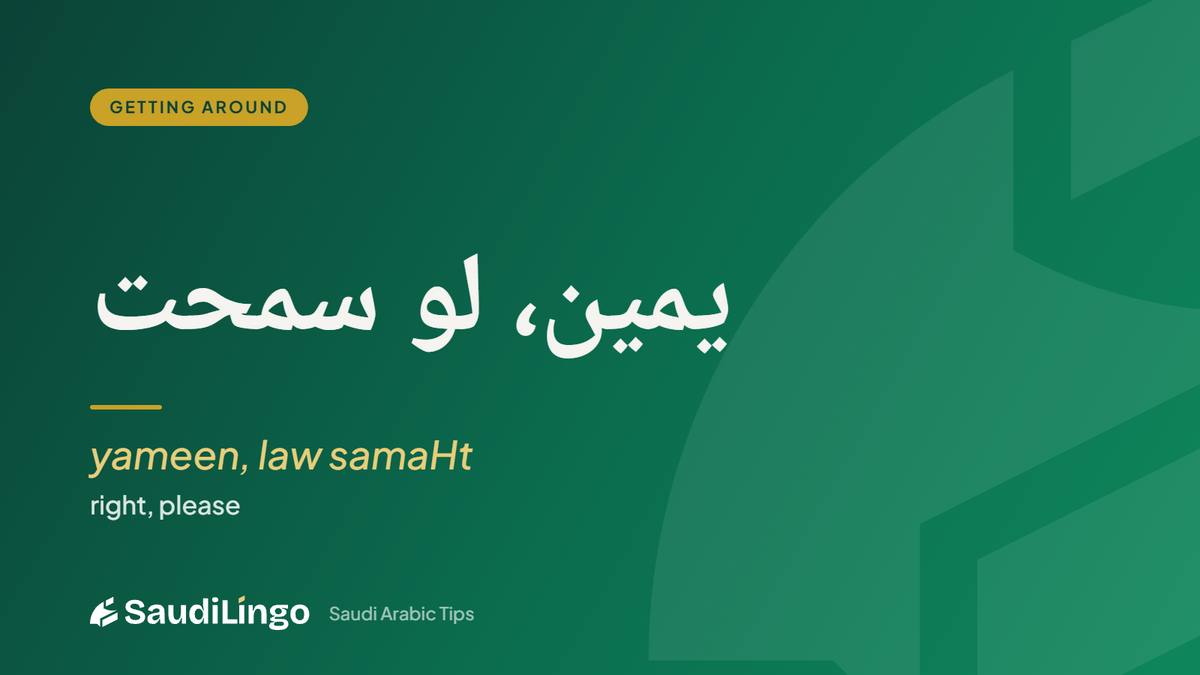
- يمين — yameen — right
- يسار — yasaar — left
- لف يمين — liff yameen — turn right
- لف يسار — liff yasaar — turn left
- سيدا — seeda — straight ahead
- على طول — 3ala Tool — keep going straight
- ارجع — irja3 — go back
- دور — door — turn around / go around
Landmarks on the road
- الإشارة — al-ishaara — the traffic light
- عند الإشارة — 3ind al-ishaara — at the traffic light
- الدوار — ad-dawwaar — the roundabout
- الجسر — al-jisr — the bridge / flyover
- النفق — an-nafag — the tunnel / underpass
- المخرج — al-makhraj — the exit
- المخرج الثاني — al-makhraj ath-thaani — the second exit
- الشارع الأول — ash-shaari3 al-awwal — the first street
- البوابة — al-bawwaaba — the gate
- المدخل — al-madkhal — the entrance
- المواقف — al-mawaagif — the car park
Stopping
- وقّف هنا — waggif hina — stop here
- هنا كفاية — hina kifaaya — here is fine
- بعد الإشارة — ba3d al-ishaara — after the light
- قبل الدوار — gabl ad-dawwaar — before the roundabout
- شوي شوي — shway shway — slowly / easy
- على اليمين هنا — 3ala al-yameen hina — on the right here
- عند البوابة الثانية — 3ind al-bawwaaba ath-thaanya — at the second gate
Two words here are worth more than the rest combined. 3ind means "at" and ba3d means "after" — string either one onto a landmark and you have a complete instruction. 3ind al-jisr. Ba3d al-bawwaaba. No verb needed.
What the Driver Will Ask You
Understanding the question is half the ride. These come up constantly, and they are short enough to recognise even at speed.
- وين؟ — ween? — Where?
- وين بالضبط؟ — ween biTH-THabT? — Where exactly?
- أي طريق؟ — ayy Tareeg? — Which road?
- من هنا ولا من هناك؟ — min hina walla min hinaak? — From here or from there?
- أدخل؟ — adkhul? — Should I drive in?
- أوقف هنا؟ — awaggif hina? — Shall I stop here?
- عندك العنوان؟ — 3indak al-3inwaan? — Do you have the address?
- كاش ولا شبكة؟ — kaash walla shabaka? — Cash or card?
Notice walla (ولا) again — it marks an either/or question. Even if you miss both nouns, hearing walla tells you a choice is being offered and a one-word answer will do.
Fares, Meters and Street Taxis
App rides are priced up front and there is nothing to discuss. Street taxis are a different world: some run a meter, many quote a flat price, and the quote for an obvious foreigner is often optimistic. Agreeing the number before you get in is normal and expected, not rude.
- بكم توصلني؟ — bikam tiwaSSilni? — How much to take me there?
- كم على المطار؟ — kam 3ala al-maTaar? — How much to the airport?
- شغّل العداد لو سمحت — shaghghil al-3addaad law samaHt — Run the meter, please
- هذا كثير — haatha katheer — That's a lot
- آخر كلام؟ — aakhir kalaam? — Final price?
- خليها خمسين — khalleeha khamseen — Make it fifty
- عندك باقي؟ — 3indak baagi? — Do you have change?
- الباقي لك — al-baagi lak — Keep the change
Numbers are the bottleneck here, and there is no way around learning them — if you cannot hear the difference between khamseen and sab3een, you cannot negotiate. Our guide to Saudi Arabic numbers and bargaining drills exactly that, and the haggling phrases transfer directly from the souq to the kerb.
Landmarks Worth Being Able to Say
Naming a landmark correctly is often faster than any address. These are the ones that come up most.
Riyadh: burj al-mamlaka (برج المملكة, Kingdom Tower), burj al-faySaliyya (برج الفيصلية), Tareeg al-malik Fahd (طريق الملك فهد), Hayy al-3ulaya (حي العليا, Olaya), ad-dir3iyya (الدرعية), maTaar al-malik Khaalid (مطار الملك خالد, King Khalid Airport).
Jeddah: al-korneesh (الكورنيش, the Corniche), al-balad (البلد, the historic old town), Tareeg at-taHliya (طريق التحلية, Tahlia Street), maTaar al-malik 3abdul3azeez (مطار الملك عبدالعزيز), an-nafoora (النافورة, the King Fahd Fountain).
On Foot: Asking a Stranger
Sooner or later the phone dies or the pin is wrong and you have to ask a human. Open with a softener — law samaHt (لو سمحت) — then ask.
- لو سمحت، وين المترو؟ — law samaHt, ween al-metro? — Excuse me, where is the metro?
- وين أقرب محطة؟ — ween agrab maHaTTa? — Where is the nearest station?
- كيف أوصل...؟ — keef awSal...? — How do I get to...?
- قريب ولا بعيد؟ — gareeb walla ba3eed? — Near or far?
- أقدر أمشي؟ — agdar amshi? — Can I walk?
- كم ياخذ وقت؟ — kam yaakhuth wagt? — How long does it take?
- ضيعت الطريق — THayya3t aT-Tareeg — I've lost my way
- ممكن تعيد؟ — mumkin t3eed? — Could you repeat that?
- الله يعطيك العافية — allah ya3Teek al-3aafya — Thank you (warm, very Saudi)
For the metro and the bus, a handful of nouns covers most signage and most answers: al-metro (المترو), al-maHaTTa (المحطة, the station), al-baaS (الباص), at-tathkara (التذكرة, the ticket), al-biTaaga (البطاقة, the card), al-khaTT al-azrag (الخط الأزرق, the blue line).
Quick Reference: Your Ride Cheat Sheet
| Arabic | Transliteration | Meaning |
|---|---|---|
| ودّني المطار | waddini al-maTaar | Take me to the airport |
| على طول | 3ala Tool | Keep going straight |
| لف يمين | liff yameen | Turn right |
| لف يسار | liff yasaar | Turn left |
| عند الإشارة | 3ind al-ishaara | At the traffic light |
| بعد الجسر | ba3d al-jisr | After the bridge |
| وقّف هنا | waggif hina | Stop here |
| هنا كفاية | hina kifaaya | Here is fine |
| بكم توصلني؟ | bikam tiwaSSilni? | How much to take me there? |
| وين بالضبط؟ | ween biTH-THabT? | Where exactly? (he asks you) |
| كم ياخذ وقت؟ | kam yaakhuth wagt? | How long does it take? |
| الله يعطيك العافية | allah ya3Teek al-3aafya | Thank you |
Common Mistakes to Avoid
- Using shimaal for "left." شمال means north, and in some dialects also left — which makes it the single most dangerous word in this article. Say yasaar for left and you will never be misunderstood.
- Reaching for textbook Arabic. Ureed an athhab ila al-maTaar is flawless Modern Standard Arabic and sounds like a news bulletin in a car. Waddini al-maTaar is what people say. We unpack that gap in Saudi Arabic vs Modern Standard Arabic.
- Pronouncing the qaf as a hard K sound from the back of the throat. In Saudi dialect it is usually a plain G: Tareeg, not Tareeq; gareeb, not qareeb. This one swap does more for how local you sound than a hundred new words.
- Getting in before agreeing the fare on a street taxi. Ask bikam tiwaSSilni? through the window. Once you are in the seat, your negotiating position is gone.
- Naming a street when you could name a neighbour. Drivers navigate by what a place sits beside. Jamb al-bagaala beats a building number nearly every time.
- Going silent when you miss something. Mumkin t3eed? costs you two seconds. Guessing costs you a detour.
Practice This Week
Do not try to use all of this on your next ride. Pick three: waddini, 3ala Tool, and waggif hina. Those three carry an entire journey from door to door. Use them every single time you get in a car this week, even when the driver speaks perfect English, until they come out without thinking.
Then add one question — kam yaakhuth wagt? — and let the answer wash over you. You will catch a number. Next week you will catch two. That is what learning a spoken dialect actually looks like.
More Videos on This Topic
Two more videos on getting around by taxi, so you can hear the phrases in a real ride.
Where to Go From Here
Directions are the fastest phrases to put to work, because you will be in a car again within a day or two — and the same sentence patterns carry straight into every other conversation you have here.
Start with 30 phrases — free
Our free PDF gives you 30 essential Saudi phrases, each in Arabic script, easy transliteration and plain English. Sent to your inbox in about a minute.
Then pick the format that fits how you learn.
- Reading and audio. Saudi Arabic for Beginners — Book 1 takes you from zero through 9 lessons with 25 native-speaker audio tracks. Book 1 + Book 2 together carry you all the way to real back-and-forth conversation.
- Watching and speaking. Speak Saudi Arabic — A1 is the full video course: 17 lessons, 48 real-world speaking challenges, and an A1 certificate at the end.
- Practising out loud with a teacher. Our private lessons are one-on-one with a native Saudi tutor.
Keep reading
- 20 common Saudi Arabic phrases — the everyday lines to start with.
- Numbers and bargaining phrases — count, ask the price, and settle a fare.
- Ordering coffee and food — café and restaurant phrases that always come in handy.
- How to greet people in Saudi Arabia — the right greeting for every situation.
- Saudi Arabic at work — office phrases that stop colleagues switching to English.
Native Saudi teachers and course designers helping English speakers talk to Saudis in their own dialect — since 2020. About us