Ordering Coffee & Food in Saudi Arabic: Restaurant and Cafe Phrases
The Saudi Arabic phrases you need to order coffee and food with confidence — from gahwa and karak to kabsa and mandi. Every phrase in Arabic script, transliteration, and English.

To order in Saudi Arabic, greet first with as-salaamu 3alaykum, then name what you want and add law samaHt (please). Traditional Saudi coffee is gahwa, poured from a dallah into small cups; karak is a sweet spiced milk tea. This guide covers café vocabulary, the questions baristas ask, dishes worth knowing, and what to say during the meal and when paying.
Arabic script, easy pronunciation and plain English — sent to your inbox in about a minute.
Saudi Arabia runs on coffee. Not as a cliché — as a genuine daily rhythm. There's the tiny cup of gahwa poured from a brass dallah at a family gathering, the flat white from a specialty roastery in Riyadh's Al-Malqa, and the sweet karak tea handed through a car window at two in the morning. Food works the same way: kabsa shared from one enormous platter, shawarma at midnight, breakfast fool with hot bread.
Which means cafés and restaurants are the single best place to practice your Arabic. The vocabulary is small, the situations repeat, and staff are almost always delighted when a foreigner tries. This guide gives you the phrases you actually need — all in the spoken Saudi dialect people use in real cafés, not Modern Standard Arabic (MSA). Every phrase appears in Arabic script, a simple transliteration, and the English meaning.
Watch the full video
Why Cafés Are the Best Place to Start Speaking
Ordering has a script. You walk in, you're greeted, you name a drink, you're asked about size or payment, you say thank you. That predictability is a gift for a learner: you can rehearse the whole exchange in your head beforehand and know roughly what's coming back at you.
It's also low-stakes. If you fumble a word, the worst outcome is that you point at the menu. Nobody's grading you. Compare that to trying to hold a conversation at a dinner party in week two, and you can see why cafés are where confidence gets built.
One note before we start: if you learned Arabic from a textbook, some of what follows will look wrong. It isn't — it's just spoken. We've written more about that gap in Saudi Arabic vs Modern Standard Arabic.
Walking In: Greetings and Getting Seated
Start with a greeting. Always. Launching straight into an order feels abrupt in a culture where the greeting is the transaction's opening move.
- السلام عليكم — as-salaamu 3alaykum — Peace be upon you (the universal greeting)
- هلا — hala — Hi (casual, very common)
- مساء الخير — masaa al-kheer — Good evening
- في طاولة فاضية؟ — fee Taawla faaTHya? — Is there a free table?
- كم شخص؟ — kam shakhS? — How many people? (they'll ask you this)
- اثنين — ithneen — Two
- نقدر نجلس هنا؟ — nagdar najlis hina? — Can we sit here?
- المنيو لو سمحت — al-menu law samaHt — The menu, please
- عندكم منيو انجليزي؟ — 3indakum menu ingleezi? — Do you have an English menu?
In most modern cafés you'll order at the counter rather than be seated, so hala followed straight by your drink is often the entire opening.
Coffee Vocabulary You'll Use Every Day
Saudi coffee culture has two distinct halves, and the words differ. Traditional Arabic coffee is gahwa — light, cardamom-heavy, served in small handleless cups called finjaan. Then there's the modern specialty scene, which borrows English terms freely.
Traditional
- قهوة — gahwa — Arabic coffee
- قهوة عربية — gahwa 3arabiyya — Arabic coffee (formal)
- فنجان — finjaan — small coffee cup
- دلة — dallah — the traditional coffee pot
- هيل — heel — cardamom
- زعفران — za3faraan — saffron
- تمر — tamr — dates (always served alongside)
- شاهي — shaahi — tea
- شاهي كرك — shaahi karak — karak tea (sweet, milky, spiced)
Modern Café
- لاتيه — latteh — latte
- كابتشينو — kabatsheeno — cappuccino
- أمريكانو — amreekano — americano
- اسبريسو — espresso — espresso
- فلات وايت — flat white — flat white
- قهوة مقطرة — gahwa mugaTTara — filter / drip coffee
- حليب — Haleeb — milk
- سكر — sukkar — sugar
- بدون سكر — bidoon sukkar — without sugar
- حار — Haar — hot
- بارد — baarid — cold / iced
- ثلج — thalj — ice
How to Actually Place Your Order
The single most useful verb here is abgha (أبغى) — "I want." It's the Saudi workhorse. MSA speakers might say ureed; nobody in a Riyadh café says that.
- أبغى لاتيه — abgha latteh — I want a latte
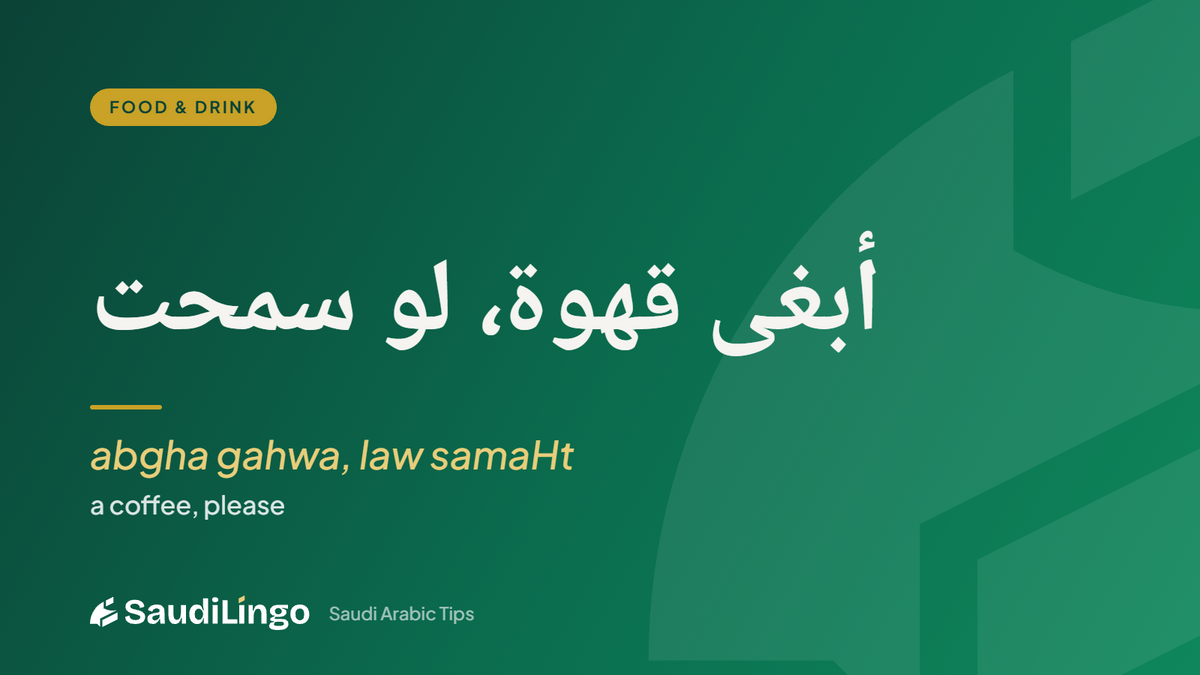
- أبغى قهوة لو سمحت — abgha gahwa law samaHt — I'd like a coffee, please
- ممكن كابتشينو؟ — mumkin kabatsheeno? — Can I have a cappuccino?
- عطني اثنين — a3Teeni ithneen — Give me two
- واحد بس — waaHid bas — Just one
- نفس الشي — nafs ash-shay — The same thing
- وش تنصح؟ — wesh tinSaH? — What do you recommend?
- وش الأشهر عندكم؟ — wesh al-ash-har 3indakum? — What's most popular here?
Wesh (وش) is the Saudi word for "what." You'll hear it constantly, and it's one of the fastest tells that someone is speaking Saudi dialect rather than Egyptian or Levantine Arabic.
Questions the Barista Will Ask You
Understanding the reply is half the battle. These four cover most of it:
- حار ولا بارد؟ — Haar walla baarid? — Hot or iced?
- سفري ولا هنا؟ — safari walla hina? — Takeaway or here?
- وش المقاس؟ — wesh al-magaas? — What size?
- كاش ولا شبكة؟ — kaash walla shabaka? — Cash or card?
Note walla (ولا) — it means "or" in these either/or questions. Once you catch it, you know a choice is being offered even if you missed the nouns.
Ordering Food: Dishes Worth Knowing
You can point at a menu forever, but knowing what the dishes actually are makes ordering far more enjoyable.
- كبسة — kabsa — spiced rice with chicken or lamb; the national dish
- مندي — mandi — meat and rice slow-cooked in an underground oven
- مطبق — muTabbag — stuffed savory pastry, folded and griddled
- شاورما — shaawarma — shawarma
- فول — fool — stewed fava beans, a breakfast staple
- تميس — tamees — large flatbread baked in a tandoor
- جريش — jareesh — crushed wheat cooked with meat and yogurt
- سمبوسة — samboosa — samosa, everywhere during Ramadan
- لحم — laHm — meat
- دجاج — dajaaj — chicken
- سمك — samak — fish
- رز — ruz — rice
- خبز — khubz — bread
- سلطة — salaTa — salad
- ماء / موية — moyaa — water
Useful Ordering Phrases
- أبغى كبسة دجاج — abgha kabsa dajaaj — I'd like chicken kabsa
- بدون بصل — bidoon baSal — without onion
- زيادة شطة — ziyaada shaTTa — extra chili
- مو حار — moo Haar — not spicy
- أنا نباتي — ana nabaati — I'm vegetarian
- فيه شي بدون لحم؟ — feeh shay bidoon laHm? — Is there anything without meat?
- عندي حساسية من... — 3indi Hasaasiyya min... — I'm allergic to...
- يكفي، شكرًا — yikfi, shukran — That's enough, thank you
That allergy phrase is worth memorizing properly rather than improvising. Follow it with the item — 3indi Hasaasiyya min al-mukassaraat (nuts) or min al-Haleeb (milk).
During the Meal, and Paying
- ممكن موية؟ — mumkin moyaa? — Can I have water?
- ممكن شوكة؟ — mumkin shawka? — Can I have a fork?
- لذيذ! — latheeth! — Delicious!
- والله زين — wallah zeen — Really good
- الحساب لو سمحت — al-Hisaab law samaHt — The bill, please
- كم الحساب؟ — kam al-Hisaab? — How much is the bill?
- ممكن فاتورة؟ — mumkin faatoora? — Can I get a receipt?
- الباقي لك — al-baagi lak — Keep the change
- سفري لو سمحت — safari law samaHt — Takeaway, please
Tipping isn't obligatory in Saudi Arabia, but rounding up or leaving 10% in a sit-down restaurant is common and appreciated. Al-baagi lak handles it neatly.
Quick Reference: Your Café Cheat Sheet
| Arabic | Transliteration | Meaning |
|---|---|---|
| أبغى لاتيه لو سمحت | abgha latteh law samaHt | I'd like a latte, please |
| حار ولا بارد؟ | Haar walla baarid? | Hot or iced? |
| سفري ولا هنا؟ | safari walla hina? | Takeaway or here? |
| بدون سكر | bidoon sukkar | No sugar |
| وش تنصح؟ | wesh tinSaH? | What do you recommend? |
| مو حار | moo Haar | Not spicy |
| ممكن موية؟ | mumkin moyaa? | Can I have water? |
| الحساب لو سمحت | al-Hisaab law samaHt | The bill, please |
| لذيذ! | latheeth! | Delicious! |
| الله يعطيك العافية | allah ya3Teek al-3aafya | Thanks / well done |
Coffee Etiquette Worth Knowing
If you're served gahwa in someone's home or a traditional majlis, a few unwritten rules apply. Take the cup with your right hand. The pours are deliberately small — one or two sips — and refills keep coming until you signal otherwise. To stop, gently shake the empty cup side to side as you hand it back. Saying "no thank you" while holding a still cup often just produces another pour.
Two or three cups is normal and polite. One is slightly abrupt; five or six is fine among friends. And dates are almost always offered alongside — accepting one is part of the ritual.
Common Mistakes to Avoid
- Using MSA vocabulary. Ureed qahwatan is grammatically perfect and sounds like a news broadcast. Say abgha gahwa.
- Mispronouncing the qaf. In Saudi dialect, qahwa becomes gahwa with a hard G. This one substitution instantly makes you sound more local.
- Skipping the greeting. Thirty seconds of as-salaamu 3alaykum, keef Haalak? changes the whole tone. Our guide to Saudi greetings covers every situation.
- Expecting to bargain. Café and restaurant prices are fixed — bargaining belongs in the souq. See our guide to numbers and bargaining for where it does apply.
- Giving up after one confused look. Repeat it once, slightly slower. Most of the time the issue is speed, not vocabulary.
Practice This Week
Pick one phrase — abgha latteh law samaHt — and use it every single time you order for a week. Don't add anything. Once it's automatic, add wesh tinSaH? and let the answer wash over you even if you only catch a word. That's how spoken fluency is actually built: one repeated exchange at a time.
Allah ya3Teek al-3aafya — now go order that coffee.
More Videos on This Topic
Two more videos on ordering coffee and food, if you want to hear the phrases spoken.
Where to Go From Here
Ordering is one of the easiest wins in the dialect, and one of the most repeated. Here is how to turn it into real conversation.
Start with 30 phrases — free
Our free PDF gives you 30 essential Saudi phrases, each in Arabic script, easy transliteration and plain English. Sent to your inbox in about a minute.
Then pick the format that fits how you learn.
- Reading and audio. Saudi Arabic for Beginners — Book 1 takes you from zero through 9 lessons with 25 native-speaker audio tracks. Book 1 + Book 2 together carry you all the way to real back-and-forth conversation.
- Watching and speaking. Speak Saudi Arabic — A1 is the full video course: 17 lessons, 48 real-world speaking challenges, and an A1 certificate at the end.
- Practising out loud with a teacher. Our private lessons are one-on-one with a native Saudi tutor.
Keep reading
- Numbers and bargaining phrases — count, ask the price, and haggle like you live here.
- 20 common Saudi Arabic phrases — the everyday lines to start with.
- How to greet people in Saudi Arabia — the right greeting for every situation.
- Family words in Saudi Arabic — what to call everyone at the gathering.
- Saudi Arabic for taxis and directions — telling a driver where to go in Riyadh and Jeddah.
Native Saudi teachers and course designers helping English speakers talk to Saudis in their own dialect — since 2020. About us