Saudi Arabic vs Modern Standard Arabic: What's the Real Difference?
Textbook Arabic and the Arabic you'll actually hear in Riyadh are not the same language. Here's exactly what changes in sound, vocabulary and grammar — and which one you should learn first.

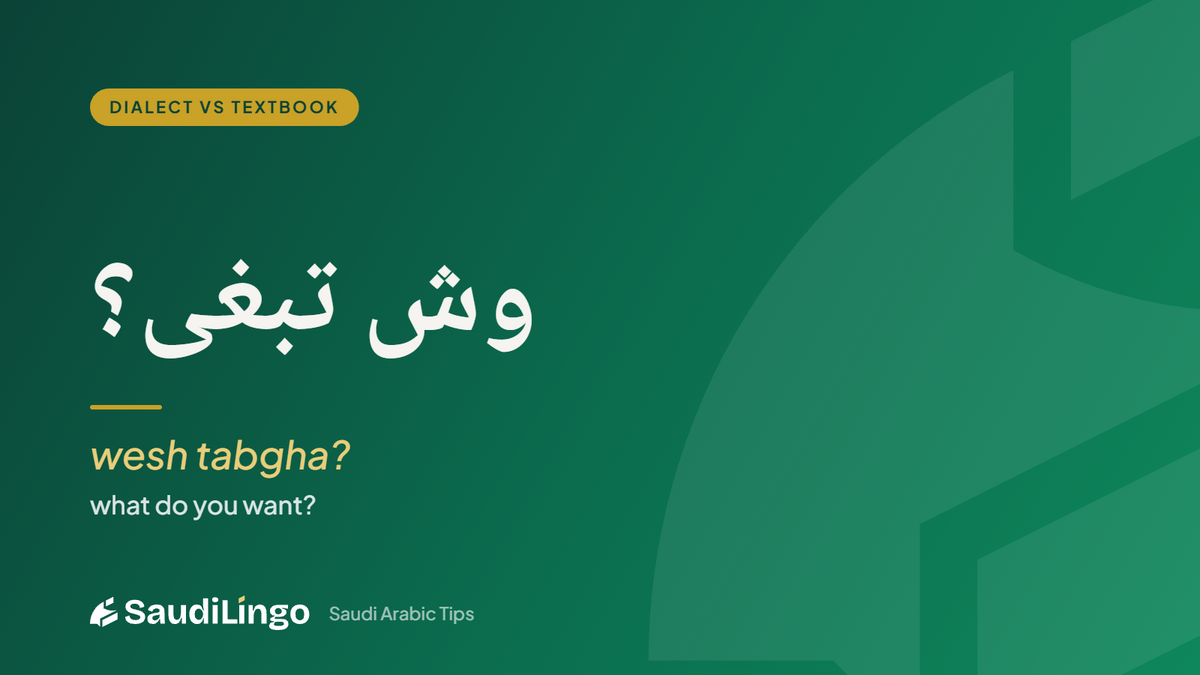
Modern Standard Arabic (MSA) is the formal Arabic of books, news and official writing. Saudi Arabic is what people in Saudi Arabia actually speak every day. They share roots, but everyday words, question words, pronunciation and grammar differ: MSA maatha tureed? and Saudi wesh tabi? both mean "What do you want?". If your goal is conversation in Saudi Arabia, start with Saudi Arabic; if you need news, reading or formal writing, learn MSA.
Arabic script, easy pronunciation and plain English — sent to your inbox in about a minute.
You sign up for an Arabic course, buy a textbook, learn to say ماذا تريد؟ (maatha tureed?) — "What do you want?" — then land in Riyadh, and the first person who talks to you says وش تبي؟ (wesh tabi?). Same meaning. Not one word in common.
This is the single most confusing thing about learning Arabic, and almost nobody explains it before you've already spent months on the wrong material. So let's fix that. Here's what Modern Standard Arabic actually is, what Saudi Arabic actually is, how they differ in sound, vocabulary and grammar — and which one you should be learning.
The short answer
Modern Standard Arabic (MSA, or الفصحى — al-fuSHa) is the formal written and broadcast language. It's what newspapers print, what news anchors read, and what nearly every Arabic textbook teaches. Nobody grows up speaking it at home.
Saudi Arabic is the spoken dialect people in Saudi Arabia actually use — with family, in the souq, at work, in WhatsApp voice notes. It's a living, everyday language, and it's what you need if your goal is to talk to people.
They're related, but not interchangeable. Think of the gap as roughly comparable to formal written Latin versus modern spoken Italian — closer than that, but the same idea: one is inherited, formal, and stable; the other is alive and moving.
What Modern Standard Arabic really is
MSA is a shared, standardized register used across all 22 Arab countries. Its enormous strength is exactly that: it's neutral. A Saudi, a Moroccan and an Iraqi can all read the same article and understand it identically.
You'll encounter MSA in:
- News broadcasts, newspapers and official documents
- Books, academic writing and formal speeches
- Religious texts and classical literature
- Road signs, contracts and government forms
What you will almost never encounter is someone ordering coffee in it. Speaking pure MSA in a Saudi café is understood — but it sounds noticeably formal, a bit like walking into a shop and announcing "I wish to procure a beverage." People will help you. They'll also gently switch to dialect, and you'll be lost again.
What Saudi Arabic really is
Saudi Arabic belongs to the Gulf dialect family, and it isn't one single uniform thing. The country is large, and the way people speak shifts as you move across it:
The main regional varieties
- Najdi (نجدي) — central Saudi Arabia, including Riyadh. The variety most people mean by "Saudi Arabic," and the one most widely recognized nationally.
- Hijazi (حجازي) — the west: Jeddah, Makkah, Madinah. Softer, historically shaped by trade and pilgrimage, with some vocabulary closer to Egyptian.
- Eastern (شرقاوي) — the Eastern Province, sharing a lot with Kuwaiti, Bahraini and Emirati speech.
- Southern (جنوبي) — Abha, Jazan and the surrounding regions.
The good news: these varieties are mutually intelligible. Learn Najdi-based Saudi Arabic and you'll be understood in Jeddah, in Dammam, and across the Gulf. At SaudiLingo we teach the widely-understood everyday Saudi speech that works nationwide — you can see exactly how that's structured in our lessons.
The differences you'll notice first
1. Everyday vocabulary is genuinely different
This is the biggest shock for textbook learners. The most common words in daily conversation — want, now, good, why, where — are often completely different words, not variations.
- Want: MSA أريد (ureed) → Saudi أبي (abi) or أبغى (abgha)
- Now: MSA الآن (al-aan) → Saudi الحين (al-Heen)
- Good: MSA جيد (jayyid) → Saudi زين (zeen)
- Very / a lot: MSA جداً (jiddan) → Saudi مرة (marra)
- Like this: MSA هكذا (haakatha) → Saudi كذا (kitha)
- I don't know: MSA لا أعرف (laa a3rif) → Saudi ما أدري (ma adri)
Notice that these aren't accents of the same word. أبي and أريد share nothing. That's why textbook study alone leaves people unable to follow a normal conversation.
2. Question words change completely
If you only memorize one list from this article, make it this one. Question words appear in nearly every exchange, and the Saudi forms are unrecognizable from the MSA ones.
- What? MSA ماذا (maatha) → Saudi وش (wesh)
- Where? MSA أين (ayna) → Saudi وين (ween)
- Why? MSA لماذا (limaatha) → Saudi ليش (leesh)
- Who? MSA من (man) → Saudi مين (meen)
- How much? MSA كم (kam) → Saudi كم (kam) — one that stays the same
So the textbook sentence أين المطعم؟ (ayna al-maT3am?) becomes وين المطعم؟ (ween al-maT3am?) — "Where's the restaurant?"
3. Pronunciation shifts in predictable ways
Saudi Arabic isn't random — the sound changes follow patterns, which makes them learnable.
The clearest one: the letter ق (qaaf), a deep throaty "q" in MSA, is usually pronounced as a hard g in Najdi speech.
- قال — MSA qaala → Saudi gaal ("he said")
- قهوة — MSA qahwa → Saudi gahwa ("coffee")
- قريب — MSA qareeb → Saudi gareeb ("close, nearby")
Here's something that will encourage you, though: Saudi Arabic keeps several classical sounds that other dialects have dropped. The letters ث (th, as in "think"), ذ (also written th in our system, as in "this") and ظ (TH) are pronounced much as they are in MSA — unlike Egyptian or Levantine Arabic, where they often shift to s, z or d. In this respect Saudi Arabic is closer to classical Arabic than most dialects, not further from it.
4. Grammar gets simpler, not harder
Learners often assume dialect means "broken" or "extra complicated." The opposite is true. Most of the grammar that makes MSA intimidating simply isn't there in speech.
- Case endings (الإعراب) disappear. The -un, -an, -in suffixes you agonize over in textbooks aren't used in conversation. كتابٌ (kitaabun) is just كتاب (kitaab).
- The dual form fades. MSA has a whole separate grammatical form for exactly two of something. Everyday Saudi speech mostly gets by without it.
- Negation is easier. Instead of MSA's set of particles (لا، لم، لن، ليس), Saudi Arabic leans on two: ما (ma) before verbs and مو (mu) before nouns and adjectives. ما أدري (ma adri) = "I don't know." مو زين (mu zeen) = "not good."
- The future is one letter. MSA سوف أذهب (sawfa ath-hab) becomes بروح (barooH) — just a b- prefix on the verb. "I'll go."
If MSA grammar has ever made you feel like Arabic is beyond you, the dialect is a genuine relief.
The same sentence, side by side
Comparisons make it concrete. Each pair below means the same thing:
- What do you want to drink?
MSA: ماذا تريد أن تشرب؟ (maatha tureed an tashrab?)
Saudi: وش تبي تشرب؟ (wesh tabi tishrab?) - How are you?
MSA: كيف حالك؟ (kayfa Haaluk?)
Saudi: كيف الحال؟ (keef al-Haal?) or وش أخبارك؟ (wesh akhbaarak?) - This is very good.
MSA: هذا جيد جداً (haatha jayyid jiddan)
Saudi: هذا زين مرة (haatha zeen marra) - I'll go now.
MSA: سأذهب الآن (sa-ath-habu al-aan)
Saudi: بروح الحين (barooH al-Heen)
Read those aloud. The Saudi versions are shorter, faster, and easier to say — which is exactly why they're the ones people use.
So which one should you learn?
It depends on your goal, and it's worth being clear-eyed about it.
Learn Modern Standard Arabic if…
- You want to read classical or religious texts in the original
- You're pursuing academic Arabic study or formal certification
- Your work is primarily with written documents, media or translation
- You want one form that's neutral across every Arab country
Learn Saudi Arabic if…
- You live in, work in, or are moving to Saudi Arabia
- You have Saudi friends, colleagues, in-laws or a partner
- You want to understand Saudi and Gulf shows, podcasts and social media
- Your goal is holding a real conversation, not passing an exam
For most people reading this, the answer is Saudi Arabic — and it doesn't lock you out of anything. Dialect and MSA share the same alphabet and a large amount of core vocabulary. Learning the spoken dialect first gives you working ears and a working mouth, and it makes MSA easier to pick up later, not harder, because you'll already have thousands of words in your head. If you still have questions about how the two fit together, we've answered the most common ones on our FAQ page.
Three myths worth clearing up
"Dialect is just slang or bad Arabic"
No. Saudi Arabic has consistent grammar, its own structures, and a vocabulary of its own — it's a full language system that around 35 million people use every day. It isn't a degraded version of anything.
"If I learn MSA, I'll understand everyone"
You'll be understood. Understanding back is the problem. Native speakers can follow MSA because of schooling and media exposure, but when they reply to each other naturally, you'll catch a fraction of it.
"I have to master MSA before starting dialect"
This belief costs learners years. There's no prerequisite. Plenty of people learn Saudi Arabic first and do fine — and they're having real conversations months earlier than the textbook route allows. Our Saudi Arabic books are built for exactly this: dialect from day one, with transliteration alongside the Arabic script so you can start speaking before your reading is perfect.
How to actually start
A sensible order of operations:
- Get the sounds first. Learn the Arabic alphabet and the Saudi pronunciation patterns — especially the ق → g shift. This unlocks everything else.
- Front-load high-frequency words. أبي، الحين، زين، وش، وين، ليش (abi, al-Heen, zeen, wesh, ween, leesh) appear constantly. Twenty words like these carry more weight than two hundred rare ones.
- Listen to real Saudi speech early. Saudi podcasts, YouTube channels and shows — even when you only catch fragments. Your ear adapts faster than you expect.
- Speak before you feel ready. Saudis are famously warm and encouraging toward anyone attempting the dialect. Mistakes get you help, not judgment.
- Use dialect-specific material. Most Arabic courses teach MSA and don't say so. Make sure what you're studying is actually the spoken language.
The bottom line
Modern Standard Arabic and Saudi Arabic aren't rivals — they're two tools for two jobs. MSA opens the written and formal world. Saudi Arabic opens people: the conversation over gahwa, the joke you finally get, the moment a colleague stops switching to English because you clearly don't need it anymore.
If that second thing is what you're after, start with the dialect. You'll be speaking far sooner than the textbook route would ever let you.
Where to Go From Here
Knowing the difference is the easy part. Closing it means picking a way to actually practise the dialect — here is the shortest route.
Start with 30 phrases — free
Our free PDF gives you 30 essential Saudi phrases, each in Arabic script, easy transliteration and plain English. Sent to your inbox in about a minute.
Then pick the format that fits how you learn.
- Reading and audio. Saudi Arabic for Beginners — Book 1 takes you from zero through 9 lessons with 25 native-speaker audio tracks. Book 1 + Book 2 together carry you all the way to real back-and-forth conversation.
- Watching and speaking. Speak Saudi Arabic — A1 is the full video course: 17 lessons, 48 real-world speaking challenges, and an A1 certificate at the end.
- Practising out loud with a teacher. Our private lessons are one-on-one with a native Saudi tutor.
Keep reading
- 20 common Saudi Arabic phrases — the everyday lines to start with.
- How to greet people in Saudi Arabia — the right greeting for every situation.
- Numbers and bargaining phrases — count, ask the price, and haggle like you live here.
- Family words in Saudi Arabic — what to call everyone at the gathering.
Native Saudi teachers and course designers helping English speakers talk to Saudis in their own dialect — since 2020. About us