Saudi Arabic at Work: Office Phrases That Make Colleagues Stop Switching to English
Saudi Arabic at work: the office phrases that stop colleagues switching to English, from abshir and ma gassart to meetings, deadlines and WhatsApp replies.

Saudi colleagues switch to English out of kindness; what stops it is using a few Saudi phrases early and often. This guide covers the first two minutes of the workday, the four words that do the most work, phrases for agreeing, disagreeing and deadlines in meetings, and what people actually type in work messages.
Arabic script, easy pronunciation and plain English — sent to your inbox in about a minute.
You walk into the meeting room and three colleagues are mid-conversation in Arabic. You sit down. Within four seconds, without anyone deciding to, the whole room has switched to English. Nobody meant anything by it — it is a kindness, and it is also the single biggest reason expats can live in Riyadh for five years and still not speak the language.
The switch is not something you can ask people to stop doing. You have to earn your way out of it, and the way out is smaller than you think: a handful of work phrases, used confidently, that signal you are worth staying in Arabic for. This guide is those phrases — in spoken Saudi dialect, the way people actually talk in an office, not Modern Standard Arabic. Each one appears in Arabic script, a simple transliteration, and the English meaning.
Watch the full video
Why Colleagues Switch, and What Actually Stops It
Your colleagues switch for three reasons: they are being polite, they assume English is faster, and — quietly — they are not sure how much you understand, so they take the safe option. All three are about uncertainty, not about your level.
So the goal is not to be fluent. The goal is to remove the uncertainty. A colleague who hears you answer abshir to a request, or ma gaSSart when they hand something over, now has evidence. Evidence is what makes someone stay in Arabic with you.
You can also just say it out loud, and it works better than people expect:
- تكلم عربي معي، أبغى أتعلم — takallam 3arabi ma3i, abgha at3allam — Speak Arabic with me, I want to learn
- لا تترجم لي، خلني أحاول — la titarjim li, khalleeni aHaawil — Don't translate for me, let me try
- عادي لو ما فهمت، أعيد لك — 3aadi law ma fihimt, a3eed lak — It's fine if I don't get it, I'll ask again
Arriving: The First Two Minutes
Office greetings in Saudi Arabia are warmer and longer than in most Western workplaces. Skipping them to get to the point reads as cold, not efficient.
- صباح الخير — SabaaH al-kheer — Good morning
- هلا بالغالي — hala bil-ghaali — Hey, good to see you (warm, for a colleague you know)
- وش الأخبار؟ — wesh al-akhbaar? — How's things?
- كيف الشغل؟ — keef ash-shughl? — How's work going?
- كيف الدوام اليوم؟ — keef ad-dawaam al-yoom? — How's the shift today?
- الحمدلله، كل شي تمام — alHamdulillah, kull shay tamaam — All good, thanks
- مشغول شوي — mashghool shway — A bit busy
If greetings are still new to you, the full range is in our guide to greetings for every situation — the office versions are a subset of those.
The Four Words That Do the Most Work
If you learn nothing else from this article, learn these. They are short, they are unmistakably Saudi, and each one replaces a whole English sentence.
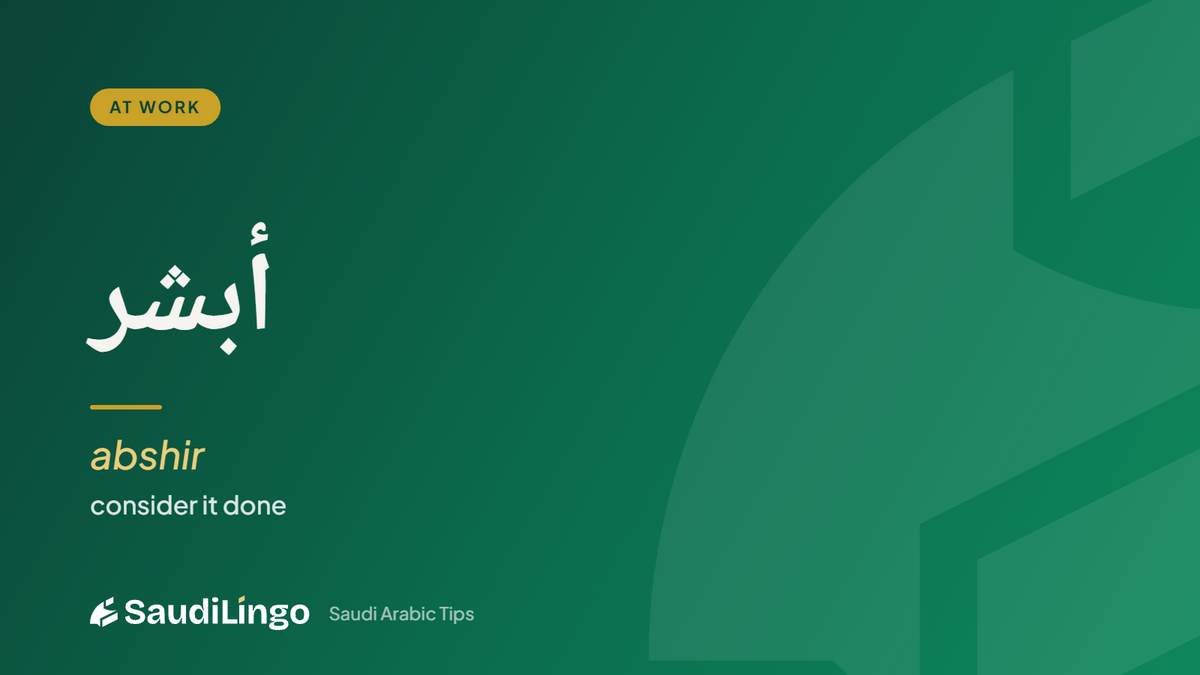
- أبشر — abshir — Consider it done / you got it
- تم — tamm — Done (the standard reply on WhatsApp and email)
- ما قصرت — ma gaSSart — You've done more than enough / thank you for the effort
Abshir is the one that gets reactions. A manager asks you for the report by Sunday, you say abshir, and you have just told them in one word that it is handled — in a register no textbook teaches. Ma gaSSart is its mirror: the warm, slightly generous thank-you Saudis give each other after someone helps.
In the Meeting
Agreeing, disagreeing, and buying time
- وش رايك؟ — wesh raayak? — What do you think?
- معك حق — ma3ak Hagg — You're right
- أتفق معك — attifig ma3ak — I agree with you
- عندي رأي ثاني — 3indi raay thaani — I see it differently
- ممكن نرجع لهذي النقطة؟ — mumkin nirja3 li-haathi an-nugTa? — Can we come back to this point?
- عطني دقيقة أفكر — a3Teeni dageega afakkir — Give me a minute to think
- ما فهمت زين — ma fihimt zeen — I didn't quite follow
- ممكن تعيد؟ — mumkin t3eed? — Could you say that again?
- ممكن تشرح لي؟ — mumkin tishraH li? — Could you explain that to me?
- يعني وش؟ — ya3ni wesh? — Meaning what exactly?
Ma fihimt zeen is worth saying out loud rather than nodding through. Nodding through is exactly what convinces a room to switch back to English next week.
Work, status and deadlines
- الاجتماع — al-ijtimaa3 — the meeting
- التقرير — at-tagreer — the report
- الملف — al-milaff — the file
- المشروع — al-mashroo3 — the project
- العميل — al-3ameel — the client
- المدير — al-mudeer — the manager
- الدوام — ad-dawaam — working hours / the shift
- إجازة — ijaaza — leave, time off
- خلصت التقرير — khallaSt at-tagreer — I finished the report
- لسه ما خلصت — lissa ma khallaSt — I haven't finished yet
- أشتغل عليه الحين — ashtaghil 3aleeh al-Heen — I'm working on it now
- ارسلت لك الملف — arsalt lak al-milaff — I sent you the file
- متى التسليم؟ — mata at-tasleem? — When is it due?
- بكرة الصبح — bukra aS-SubH — Tomorrow morning
- نحتاج وقت أكثر — niHtaaj wagt akthar — We need more time
- محتاج مساعدة — miHtaaj musaa3ada — I need help
Times and dates carry a lot of weight in these sentences, and the numbers underneath them are the same ones you use everywhere else — our guide to Saudi Arabic numbers is the fastest way to get them solid.
Messages: What People Actually Type
Most Saudi office communication happens on WhatsApp, and written dialect is shorter and warmer than spoken. These are the lines you will see every day.
- تم، شكرًا — tamm, shukran — Done, thanks
- وصلني — waSalni — Got it / received
- إن شاء الله — in shaa allah — God willing (used constantly about future plans)
- الله يعطيك العافية — allah ya3Teek al-3aafya — Thank you for your effort
- يعطيك العافية على الشرح — ya3Teek al-3aafya 3ala ash-sharH — Thanks for explaining
- أرجع لك — arja3 lak — I'll get back to you
- خلني أراجع وأرد عليك — khalleeni araaji3 w-arid 3aleek — Let me check and reply
- لو سمحت، متى تقدر ترسله؟ — law samaHt, mata tigdar tirsilah? — When can you send it, please?
One cultural note about in shaa allah: at work it genuinely means "if all goes well," not "no." If you need certainty on a date, ask for one directly — mata biTH-THabT? (متى بالضبط؟ — when exactly?) — and nobody will take offence.
Quick Reference: Your Office Cheat Sheet
| Arabic | Transliteration | Meaning |
|---|---|---|
| أبشر | abshir | Consider it done |
| تم | tamm | Done |
| على راسي | 3ala raasi | Gladly |
| ما قصرت | ma gaSSart | Thanks for the effort |
| وش رايك؟ | wesh raayak? | What do you think? |
| معك حق | ma3ak Hagg | You're right |
| ما فهمت زين | ma fihimt zeen | I didn't quite follow |
| ممكن تعيد؟ | mumkin t3eed? | Could you repeat that? |
| أشتغل عليه الحين | ashtaghil 3aleeh al-Heen | I'm on it now |
| متى التسليم؟ | mata at-tasleem? | When is it due? |
| محتاج مساعدة | miHtaaj musaa3ada | I need help |
| الله يعطيك العافية | allah ya3Teek al-3aafya | Thank you for your effort |
Common Mistakes to Avoid
- Waiting until your Arabic is "good enough." It never becomes good enough in private. The switch to English stops when colleagues see you using the language badly and cheerfully, not when you arrive fluent.
- Using Modern Standard Arabic in the office. Hal yumkinuka musaa3adati? is correct and sounds like a press conference. Mumkin tsaa3idni? is what a colleague says.
- Pronouncing the qaf from the back of the throat. In Saudi dialect it is usually a plain G: Hagg, tagreer, dageega. One swap, instantly more local. More on that gap in Saudi Arabic vs Modern Standard Arabic.
- Skipping the greeting to save time. The two minutes of wesh al-akhbaar? before business are not a delay. They are the business.
- Nodding when you missed it. Say ma fihimt zeen. It costs nothing and it keeps the conversation in Arabic.
- Reading in shaa allah as a refusal. It usually is not. If you need a date, ask mata biTH-THabT?
Practice This Week
Pick two: abshir and ma gaSSart. Use abshir every time someone asks you for something, and ma gaSSart every time someone hands you something. That is maybe six uses a day, in situations that repeat forever.
Then add one question — wesh raayak? — in your next meeting. You will get an answer in Arabic, you will miss half of it, and that is the point. The half you catch this month becomes the whole thing by spring.
More Videos on This Topic
Prefer to watch a story? Follow a first day at work in Saudi Arabia, with the same kind of everyday office Arabic.
Where to Go From Here
Office Arabic is the fastest to put to work, because the same twenty situations come back every single day — and once colleagues stop switching, your practice becomes free.
Start with 30 phrases — free
Our free PDF gives you 30 essential Saudi phrases, each in Arabic script, easy transliteration and plain English. Sent to your inbox in about a minute.
Then pick the format that fits how you learn.
- Reading and audio. Saudi Arabic for Beginners — Book 1 takes you from zero through 9 lessons with 25 native-speaker audio tracks. Book 1 + Book 2 together carry you all the way to real back-and-forth conversation.
- Watching and speaking. Speak Saudi Arabic — A1 is the full video course: 17 lessons, 48 real-world speaking challenges, and an A1 certificate at the end.
- Practising out loud with a teacher. Our private lessons are one-on-one with a native Saudi tutor.
Keep reading
- 20 common Saudi Arabic phrases — the everyday lines to start with.
- How to greet people in Saudi Arabia — the right greeting for every situation.
- Saudi Arabic for taxis and directions — getting around Riyadh and Jeddah.
- Ordering coffee and food — café and restaurant phrases you will use this week.
Native Saudi teachers and course designers helping English speakers talk to Saudis in their own dialect — since 2020. About us